IVF Thailand: Your Practical Guide to Choosing the Best IVF Clinic and Plan
IVF Thailand is a top choice for many couples seeking high-quality fertility care abroad, and this guide will help you decide confidently. Right away, you’ll learn what to expect from Thailand IVF clinics, typical IVF cost in Thailand, and how IVF Bangkok specialists handle each step of the process.
Why do patients choose IVF medical tourism in Thailand
Thailand combines strong medical expertise and welcoming service, which makes it a popular destination for assisted reproductive technology. Secondly, many clinics offer English-speaking staff and International Patient Services, so international patients feel supported.
In addition, competitive pricing and integrated travel services simplify logistics. For example, medical tourism reports note that Thailand’s fertility packages are often more affordable than Western alternatives (Patients Beyond Borders, 2019). Finally, specialist centers in Bangkok and other cities provide comprehensive care from consultation to embryo transfer.
Understanding fertility treatment in Thailand: services and scope
IVF Thailand centers offer a full suite of fertility treatments, including ovarian stimulation, egg retrieval, embryo culture, embryo transfer Thailand, egg freezing Bangkok, and preimplantation genetic testing Thailand (PGT). Many centers also provide infertility consultation, donor programs, and fertility preservation.
Consequently, patients can access tailored plans, whether they need low-cost IVF Thailand options or advanced PGT for single-gene disorders.
IVF cost in Thailand: typical pricing and what affects price
IVF costs in Thailand vary by clinic, treatment plan, and additional services. Generally, a basic IVF cycle in Thailand ranges from approximately $3,000 to $7,000 USD, while packages with PGT, donor eggs, or multiple cycles can be more expensive.
Furthermore, add-ons like egg freezing in Bangkok or embryo vitrification increase totals. According to Patients Beyond Borders (2019), costs in Thailand are often lower than in parts of Europe, while maintaining high standards of care. Therefore, when comparing clinics, account for included services, medication costs, and possible travel-related expenses.
IVF success rates Thailand: how to interpret numbers
When assessing IVF success rates in Thailand, remember that outcomes depend on age, diagnosis, clinic protocols, and laboratory quality.
For women under 35, many reputable IVF Bangkok specialists report live birth or clinical pregnancy rates per embryo transfer in the 40–60% range, whereas rates decline with age. For a balanced context, refer to clinic-specific published data and ask for age-stratified IVF success rates by age in Thailand clinics before deciding.
Choosing the best IVF clinics in Bangkok for international patients
Start by narrowing candidates to clinics with strong international patient services, certified laboratories, and transparent pricing. Then, check accreditation and affiliations, the experience of Bangkok IVF specialists, and whether they offer follow-up care for overseas patients. Also, read patient reviews and request detailed success-rate breakdowns and treatment timelines.
Moreover, consider practical matters like English language support, travel coordination, and on-site lodging packages. If you want a step-by-step IVF process at Thai fertility centers, ask clinics for a sample timeline from consultation to embryo transfer and frozen embryo transfer (FET).
Step-by-step IVF process at Thai fertility centers
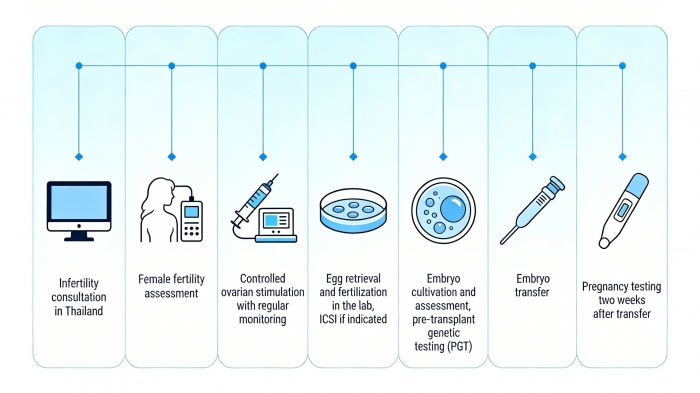
First, begin with an infertility consultation in Thailand, often done virtually for international patients.
Next, a female fertility assessment checklist typically includes hormone tests, an ultrasound, and infectious disease screening.
Then, controlled ovarian stimulation follows, with regular monitoring.
After that, egg retrieval and fertilization in the lab occur, including ICSI if indicated.
Subsequently, embryos are cultured and assessed; at this stage, some patients choose preimplantation genetic testing (PGT) options at Thai IVF centers.
Finally, embryo transfer is scheduled, and pregnancy testing follows about two weeks after transfer. Meanwhile, clinics coordinate medication instructions and local follow-up. This clear flow helps international patients plan travel and recovery.
How to compare packages and choose the right IVF package in Thailand
Compare packages by evaluating what’s included: medications, monitoring visits, lab procedures, embryo freezing, PGT, and international patient services. Next, request a cost breakdown and ask about refund policies or guarantees. Additionally, consider low-cost IVF Thailand options only if labs meet quality standards; otherwise, a slightly higher-cost plan with proven success rates may be a better value.
For a stepwise guide to choosing the right IVF package in Thailand, make a checklist of priorities—cost, success rates, location, and follow-up care—and score packages against it.
Practical travel checklist for IVF medical tourism to Thailand
Before you travel, confirm visa and travel requirements, and then schedule a preliminary online consultation with your chosen clinic.
Pack prescriptions, previous medical records, and a female fertility assessment checklist if available.
Also, book flexible flights and accommodation close to the clinic, and allow time for multiple monitoring visits.
Furthermore, arrange local support for recovery and a plan for follow-up testing once you return home.
For a detailed travel checklist for IVF medical tourism to Thailand, ask the clinic’s international patient team for their recommended itinerary.
Real patient logistics: timeline and expected stays
Typically, an initial consultation and baseline tests can be done remotely. Then, expect 2–4 weeks for a fresh IVF cycle, including stimulation and egg retrieval, though embryo transfer timing varies. If using frozen embryo transfer or PGT, plan for longer stays or multiple short trips. Also, allow recovery days post-retrieval and arrange local support. Your clinic’s international coordinator will often provide a sample timeline tailored to your plan.
Conclusion
IVF Thailand offers practical, high-quality fertility care options for international patients, and with careful planning, you can find the best IVF clinics in Bangkok for international patients. As you prepare, compare IVF success rates in Thailand and IVF cost in Thailand, confirm legal and travel details, and choose a package that matches your goals.
Finally, remember that clear communication with IVF Bangkok specialists and careful scheduling will make your IVF Thailand experience smoother and more reassuring.