ENGLISH
 中文
 ไทย
Does Ectopic Pregnancy Show Positive Test? Ectopic Pregnancy Symptoms & What the Pain Feels Like
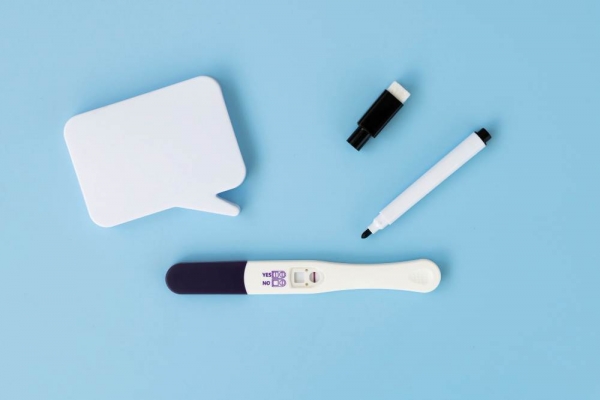
Does ectopic pregnancy show positive test? Yes. Ectopic pregnancy tissue, most often implanted in the fallopian tube, still produces hCG, so home pregnancy tests can return a positive result.
This guide covers what ectopic pregnancy pain feels like and the urgent symptoms that require immediate medical help.
Does an Ectopic Pregnancy Show a Positive Test?
The short answer is yes. A home pregnancy test detects human chorionic gonadotropin (hCG), the hormone produced by pregnancy tissue. As the NHS outlines, an ectopic pregnancy can yield a positive pregnancy test because pregnancy tissue is present and produces hCG.
In an ectopic pregnancy, however, this tissue implants outside the uterus, most often in a fallopian tube. Though it continues to secrete hCG, the pregnancy cannot develop normally into a viable pregnancy.
This is exactly why ectopic pregnancy carries hidden risk: it may look just like a normal early pregnancy on a urine test while complications develop silently.
It is also important to note that a negative test cannot fully rule out an ectopic pregnancy. The more meaningful question is not whether the test comes back positive, but how hCG levels change over time.
Why hCG Levels Behave Differently in an Ectopic Pregnancy
In a healthy intrauterine pregnancy, hCG rises predictably in early gestation. The American College of Obstetricians and Gynecologists (ACOG) defines a rise of less than 53% over 48 hours as suggestive of an abnormal pregnancy. Some clinical protocols use a more conservative threshold of 35% for safety.
An ectopic pregnancy often produces a slower, plateauing, or erratic hCG rise. A single value cannot distinguish location, but a serial trend can flag that something is not progressing normally.
This is why a clinician may ask you to repeat the blood test in 48 hours rather than relying on one number or one urine test.
What Does Ectopic Pregnancy Pain Feel Like?
Ectopic pregnancy pain has distinct features, and it often comes with other warning signs. The table below summarises key details from ACOG and NHS guidance:
|
Feature |
Details |
|
Typical location |
One-sided, lower abdominal pain |
|
Pain quality |
Sharp, stabbing; may start as a dull ache and grow worse |
|
Pattern |
Constant, or comes and goes in waves |
|
Prevalence |
Abdominal pain occurs in 90%-100% of ectopic pregnancies (ACOG) |
|
Common accompanying symptom |
Vaginal bleeding or brown discharge (NHS) |
|
Red flag emergency sign |
Worsening pain + vomiting, may signal fallopian tube rupture |
The classic pain of an ectopic pregnancy is one-sided, lower abdominal pain. ACOG lists abdominal pain as present in 90% to 100% of ectopic pregnancies, making it the most consistent symptom. The pain may begin as a dull ache and intensify.
Vomiting alongside worsening pain may indicate that the fallopian tube has ruptured, which is a surgical emergency.
The Dangerous Sign: What Does Ectopic Pregnancy Shoulder Pain Feel Like?
Shoulder pain in ectopic pregnancy is not a muscular ache. It is specifically pain at the tip of the shoulder, where the shoulder ends and the arm begins. Per NHS guidance, this is a sign of internal bleeding. It requires emergency care, not a routine check-up.
This symptom stems from referred pain. Internal bleeding from a ruptured or leaking ectopic pregnancy irritates the diaphragm. Since the diaphragm and shoulder tip share nerve pathways, the brain registers the irritation as shoulder pain.
This new shoulder-tip pain often gets worse when lying down and does not ease with pain medication. Therefore, the best course of action is to seek medical treatment as soon as possible to prevent the situation from getting worse.
Can an Ectopic Pregnancy Be Seen on Ultrasound?
A transvaginal ultrasound can sometimes visualize an ectopic pregnancy, but a scan that does not show one does not rule it out.
The limitation is partly a matter of hCG level. ACOG recommends a discriminatory zone of 3500 mIU/mL. Above this threshold, a normal intrauterine pregnancy should generally be visible on a high-quality transvaginal scan.
But a 2026 study published in BMJ Open found that 86.0% of ectopic pregnancies occurred when hCG was below the 3500 mIU/mL discriminatory zone.
Clinically, this means an empty uterus on ultrasound, combined with an hCG level below the discriminatory zone, is a pregnancy of unknown location until proven otherwise. It requires repeat hCG testing and repeat imaging, not a single reassuring scan.
When to Seek Emergency Care & Next Steps
Two different situations call for two different responses.
Emergency Red Flags: Signs of Tubal Rupture or Internal Bleeding
Seek emergency care immediately if you have a positive pregnancy test and any of the following:
1. Sudden, severe one-sided lower abdominal pain;
2. Pain at the tip of the shoulder;
3. Dizziness or fainting;
4. Persistent vomiting that makes it impossible to keep fluids down.
These are signs of possible tubal rupture or internal bleeding. Call emergency services or go to the nearest emergency department. Do not wait for an appointment.
Non-Emergency Assessment & Next Steps
Seek urgent but non-emergency assessment if you have a positive pregnancy test with mild cramping, light spotting, or a known history of ectopic pregnancy.
Early pregnancy assessment can arrange serial hCG measurements and transvaginal ultrasound at the right intervals, rather than relying on a single test.
If you have a positive pregnancy test, mild cramping, or a prior history of ectopic pregnancy and wish to protect your future fertility, proactive early pregnancy assessment is wise.
For patients undergoing fertility treatment with us, our [Early Pregnancy Assessment services in Bangkok] include professional monitoring such as serial hCG testing and transvaginal scans to evaluate your pregnancy status. If urgent, life-threatening signs develop, please seek emergency care immediately.
Conclusion
Does ectopic pregnancy show positive test? However, that fact alone does not confirm the diagnosis. A positive result paired with one-sided pelvic pain calls for prompt medical evaluation.
Ectopic pain is usually unilateral and sharp. Shoulder-tip pain is a critical red flag for internal bleeding and requires emergency care. It is also important to remember that a normal ultrasound scan cannot rule out ectopic pregnancy, particularly when hCG levels sit below the discriminatory zone.
If you have a positive pregnancy test and experience pain, seeking professional assessment without delay is the safest choice.
FAQ
1. How common is ectopic pregnancy with an IUD?
Ectopic pregnancy is rare while using an IUD (intrauterine device). If pregnancy does happen with an IUD in place, the chance of it being ectopic is higher than in people without an IUD. Any positive pregnancy test with an IUD requires urgent medical assessment.
2. Can you miscarry an ectopic pregnancy?
In rare cases, an ectopic pregnancy may resolve spontaneously, which is sometimes called a tubal miscarriage. However, this cannot be safely confirmed at home.
All suspected ectopic pregnancies need clinical monitoring, as spontaneous resolution cannot rule out life-threatening internal bleeding.
3. Can you still get pregnant after an ectopic pregnancy?
Many people go on to have successful intrauterine pregnancies after one ectopic pregnancy. Your outlook depends on whether your fallopian tube was preserved, the cause of the ectopic, and your remaining tubal health. If you have recurrent ectopic risk, fertility specialists can help plan conception safely.
4. Is an ectopic pregnancy considered a miscarriage?
No. A miscarriage means the pregnancy loss of an intrauterine pregnancy. An ectopic pregnancy is implantation outside the uterus, a separate, potentially emergency condition. It is not classified as a miscarriage or a standard abortion.